















Estimated reading time: 4 minutes
The memory of a beloved wife and mother was commemorated in bright lunar dust on April 6 as four humans flew around the moon for the first time in more than 50 years.
In keeping with a seminal tradition of exploration, Artemis II astronauts Reid Wiseman, Victor Glover, Christina Koch, and Jeremy Hansen announced their intention to name two unnamed craters on the lunar surface as they prepared to begin their lunar flyby.
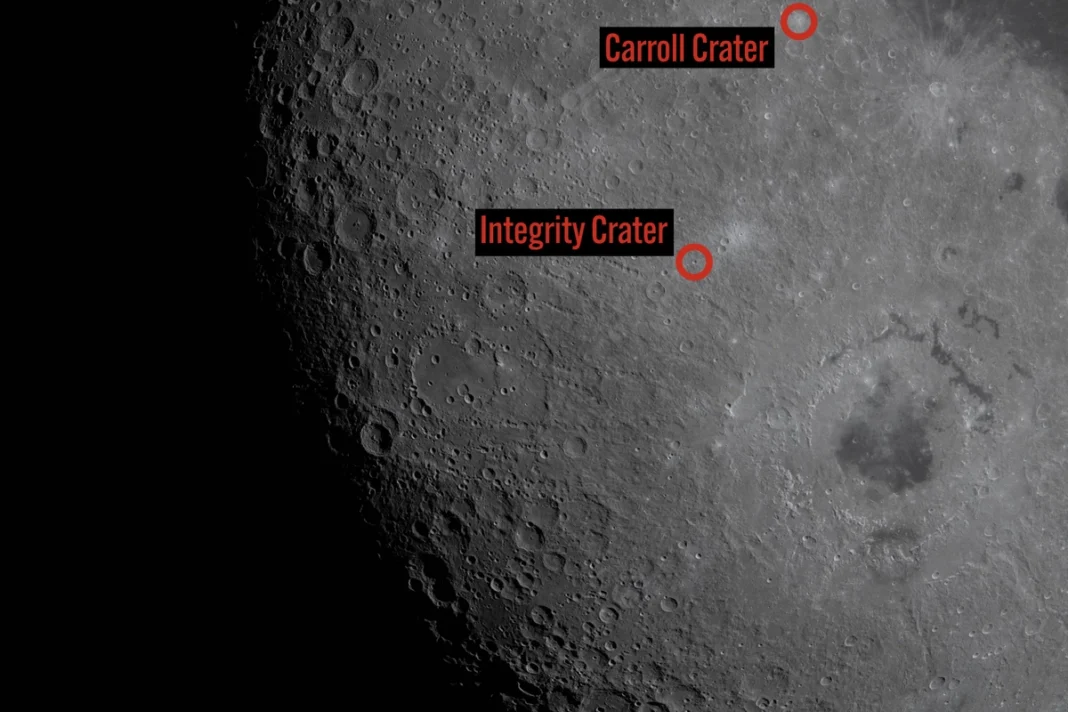
One of them, on the nearside of the moon, would be named Carroll, after Wiseman’s wife, who died in 2020 after a battle with cancer.
“There’s a feature in a really neat place on the moon, and it is on the near-side/far-side boundary,” Hansen said. “In fact, it’s just on the nearside of that boundary, so at certain times of the moon’s transit around the earth, we will be able to see this from Earth.”
Hansen then spelled her name for the record: “C-A-R-R-O-L-L.”
Tears began to flow from all four faces in the capsule, as well as from countless others in mission control and support rooms across Johnson Space Center in Houston.
Those back on Earth had no idea the astronauts had begun preparing for this several weeks earlier, when they approached the lunar science team asking for guidance on what features on the lunar surface were due for a name.
“We let them know that there’s a tradition of Apollo astronauts and also robotic explorers, you know, or robotic satellites,” Jacob Richardson, Artemis II’s deputy lunar science lead, told The Epoch Times on April 8. “When they get to the moon, and they see things for the very first time, they’re able to name things.”
“That’s how we build out our lunar map and our Martian map, and all the solar system, including the Earth, right?” he said. “You go to a place, first, you find things, and you name them, so that we have a shared common language about what we’re looking at.”
Perhaps one of the most famous examples from the Apollo era came during Apollo 8 when Jim Lovell named a mountain on the eastern edge of the Sea of Tranquility after his wife, Marilyn. The Lovells were one of the few couples of the astronaut corps of that era that remained married.
Richardson said there were still countless unnamed craters on the lunar surface, but for a name to become official—to become adopted by the International Astronomical Union (IAU)—it had to be for a feature that was “interesting scientifically.”
So his team provided the crew with some mountain ranges and craters they deemed to be suitable candidates and let the astronauts do what they thought was best.
“I don’t think anybody on the team knew what they were planning to do with that information,” said Richardson, who watched the announcement with his team from the Science Evaluation Room.
“Obviously, it was their prerogative to do something that was special. We all broke down.”
Wiseman, meanwhile, told reporters that naming a crater after his wife was not his idea. Glover, Koch, and Hansen approached him about the idea when they entered quarantine ahead of their launch.
The mission commander said he loved the idea but admitted that he would not be able to give the speech when the time came. So Hansen said he would do it.
“I think when Jeremy spelled Carroll’s name, C-A-R-R-O-L-L, I think for me, that’s when I was overwhelmed with emotion,” Wiseman said.
Then he noticed all of his crewmates beginning to well up with emotion. The moment ended with a group hug and tissues being passed around.
“For me personally, that was kind of the pinnacle moment of the mission,” he said. “For me, that was, I think, where the four of us were the most forged, the most bonded, and we came out of that really focused on that day ahead.”
The crew also named a crater on the moon’s far side Integrity, in honor of their Orion spacecraft.
NASA has released images of the moon in which it identifies the newly named craters, and it announced that both proposed names would be formally submitted to the IAU when the crew returned home.
The IAU told The Epoch Times in an email that the proposals would be reviewed and decided by the Working Group for Planetary System Nomenclature.
“The IAU followed the historic Artemis 2 mission with great interest,” Ramasamy Venugopal, press and media coordinator for the union, said. “We congratulate the astronauts and the teams for their fantastic technical achievements and for inspiring the world once again. We look forward to receiving the naming proposals from NASA.”
The name “Mount Marilyn” was adopted by the IAU in 2017.
The Epoch Times