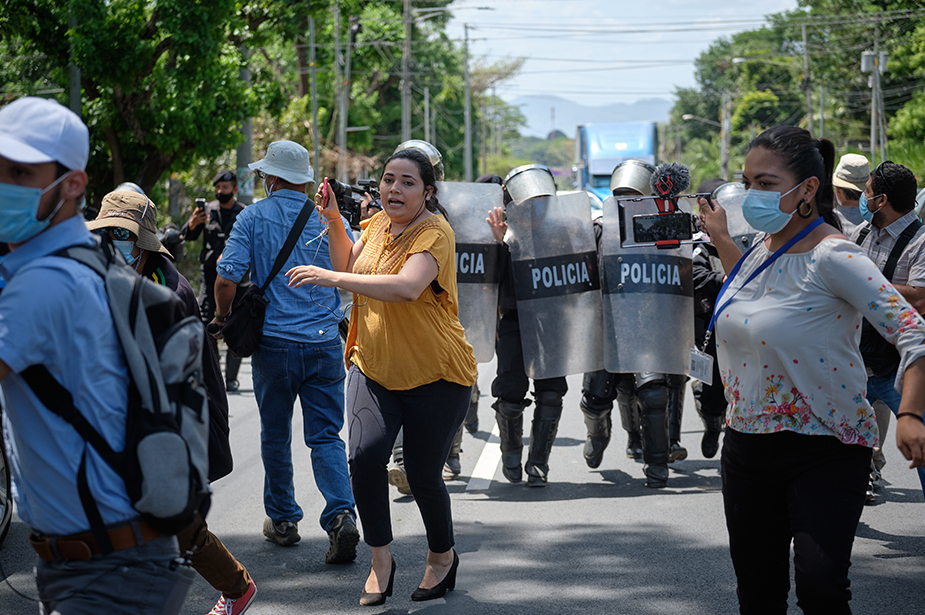















Facing a rise in authoritarianism and declines in press freedom across Central America, journalists and researchers have recognized an urgent need for collaboration.
During a Dec. 3, 2025, webinar organized by the Knight Center for Journalism in the Americas to explore Central American journalism amid democratic backsliding, the effects of repression and efforts to overcome it dominated the conversation.
“It is possible to do good journalism against all odds, against the horrible conditions that are often experienced in some of these countries,” Mexican scholar Manuel Alejandro Guerrero said.
Guerrero was joined by Guatemalan journalist Daniel Villatoro; Maryorit Guevara, founder and director of La Lupa of Nicaragua; and Sergio Arauz, deputy editor of El Faro of El Salvador. Summer Harlow, associate director of the Knight Center, moderated.
The webinar, in Spanish, helped launch a new ebook, “Periodismo en Centroamérica frente al retroceso democrático” (Journalism in Central America facing democratic backsliding), published by the Knight Center in collaboration with Estudio Abierto.
“I think we’re at a critical moment, and there are two phenomena that, for me, represent the biggest problem we have now,” said Villatoro, ebook co-author and director of Estudio Abierto.
The first, he said, is the transformation of the traditional business models for media outlets and the growth of technology. The second is the prevalence of political attacks.
The book examines the perspectives of journalists, as well as journalism support networks, in Guatemala, El Salvador, Honduras and Nicaragua. It takes a special look at women, community journalists and members of the LGBTIQ+ community.
In addition to interviews, the authors analyzed the media, political and legal environments in each country.
Guerrero, who also co-authored the book, said the study takes a systemic and structural perspective of the region, but also tries to look at each country individually.
For example, he said that Honduras is facing a breakdown of institutions so that violence against journalists can come from anywhere – maybe criminal groups, the government, or any other actor. Meanwhile, in Guatemala, a president who expresses concern for human rights is up against conservative interests without incentive to respect freedoms of the press and expression.
“We find that Central America is [normally] discussed as a single region, and yet it has very specific problems that people who practice journalism in these regions know,” he said. “They are aware of these distances and differences. It’s not the same to do journalism in Honduras as it is in Guatemala, Nicaragua or El Salvador.”
Press freedom in Central America
Guevara is one of the 268 Nicaraguan journalists estimated to be in exile.
“In Nicaragua, practicing journalism is impossible while inside the country,” she said. “There is no free press in Nicaragua. What exists is persecution, criminalization, confiscations and imprisonment of independent journalists.”
In Nicaragua, she said, there is a propaganda apparatus under the regime of husband and wife, President Daniel Ortega and co-President Rosario Murillo.
Yet, even before the government began closing and confiscating media outlets in April 2018 and imprisoning journalists, press freedom was under attack in Nicaragua.
“There has also been no access to official sources since 2007 when Daniel Ortega returned to power,” she said. “Rosario Murillo announced that she would promote uncontaminated communication, which meant limiting statements and press conferences for journalists.”
Now, Nicaragua sits alongside Venezuela and Cuba as the Latin American country with the most exiled journalists, some of whom continue their work.
“The journalism that exists is in resistance; it’s an act of civic resistance, ultimately, in informing a citizenry that is afraid but needs this information more than ever,” she said.
Arauz, who is also president of the Association of Journalists of El Salvador (APES, for its Spanish acronym), discussed the transformation his country has undergone in the past 12 months.
“This year in El Salvador things changed dramatically and unexpectedly for many of the journalists in the country,” Arauz said.
Like him, at least 53 journalists from the country have been forced into exile this year.
“The profile of the journalist who is in exile is the journalist who has to decide between two things, either to remain silent, to self-censor, or to continue doing his job without fear of repercussions, and in that sense he chooses to try to remain relevant as a journalist by doing his job from abroad or from wherever he can,” he said.
Journalists working to hold power to account or those doing complex and in-depth investigations and specializing in themes like the environment, gender or fact-checking have been particularly affected, he said.
Some were spied on with Pegasus spyware and some have left due to rumors that they would be imprisoned after publishing major investigations. Media outlets and journalist associations were also forced to leave.
Those left behind work under precarious conditions.
“I’m talking about living in fear, with police visits to their homes, with controls that haven’t existed in the last 35 years,” Arauz said. “I think that’s why academia and this type of study contribute a lot. [Journalists live under] a general crisis of the profession and the media that we don’t quite understand.”
Arauz pointed to the need for research on how journalists within the country continue to do their work, particularly when media that receive international funding are now being restricted by the new Foreign Agents Law. Other media outlets – like television or radio stations – don’t have the option to leave because their concession is tied to the country, he said.
How to work from exile
Once they leave home, Nicaraguan journalists working in digital outlets from exile confront low pay and trouble sustaining their projects, Guevara said. Doing journalism from a distance is also made difficult by “transnational persecution” of the press and sources.
A recent report from the Association of Independent Journalists and Communicators (PCIN) of Nicaragua pointed to “an increase in the perception of insecurity and fear [among journalists] of being victims of government repression, even in exile.” It said this came principally after the June murder of Ortega critic and retired army officer Roberto Samcam in Costa Rica.
To continue working in exile, Guevara said she first emphasizes rigor and the basic elements of journalism, and then looks to collaboration between media outlets and journalists not only from Nicaragua, but the region generally.
Arauz said he has gotten advice from colleagues from Nicaragua, Venezuela and Cuba about how to do journalism from exile, and specifically, how to survive. He also emphasized the importance of collaboration as something “that’s deeply ingrained,” and that should happen organically, based on mutual interests.
Moving forward
Beyond looking at the tragedies and challenges being confronted by the Central American press, Villatoro emphasized achievements in storytelling and investigation from the region’s journalists.
“That level of talent exists in Guatemala, El Salvador, Honduras and Nicaragua,” he emphasized.
Additionally, he pointed to journalist associations, like APES, PCIN, No Nos Callarán (Guatemala) and the Central American Network of Journalists, which are working nationally and regionally to resist and promote solidarity.
The journalists and authors gathered for the webinar also addressed other factors affecting journalism in the region and in each country.
They discussed how media are and should be using artificial intelligence, as well the potential threats posed to journalism by large language models (LLMs).
They talked about credibility and communicating the value of journalism to audiences in contexts where disinformation and lies thrive.
And finally, they offered advice on how colleagues in authoritarian countries can prepare for what may lie ahead, especially if the time comes to leave.
Watch these discussions and the entire webinar for free on the Knight Center’s YouTube page. (https://latamjournalismreview.org/articles/central-american-journalists-discuss-reporting-and-resistance-amid-democratic-backsliding/)