















Estimated reading time: 6 minutes
For centuries, the world’s largest navies focused on building massive warships to dominate the seas.
“Now small boats have their day in the sun,” thanks to drone technology, says B. Barrett “Barry” Hinckley, president of Blue Ops, a U.S.-based maker of unmanned surface vessels (USVs).
Those self-driving drone boats can play big roles in naval operations, ranging from reconnaissance to attacks—a fact that the federal government acknowledges.
“Robotic and autonomous systems … will play a central role in future conflicts,” states America’s Maritime Action Plan, which the White House released Feb. 13.
Unmanned systems are “cheaper to build … than manned surface combatants and submarines,” the plan says, noting they can be an important complement to massive, much more expensive vessels.
The Iran War has further underscored the need to accelerate American USV production, Hinckley and other industry executives told The Epoch Times.
This shift toward drone boats represents a significant, evolving change in naval strategy and operations.
Recent Middle East scenarios have shown that “there are so many ways that an enhanced USV force could be helpful to America and her allies,” Hinckley said.
After joint U.S.-Israel air strikes against Iran, the Iranians retaliated by effectively blocking the Strait of Hormuz, a vital oil-shipping lane between Iran and the Arabian Peninsula.
Iranians took credit for using airborne drones to attack at least one oil tanker in the Persian Gulf region.
Another was hit with a USV, United Kingdom Maritime Trade Operations reported, although the report did not specify whether Iran was responsible.
Iran has also threatened to deploy various types of sea mines that can blow up vessels.
These threats, coupled with insurance risks, created a de facto shutdown of the Strait, which usually moves about one-fifth of the world’s oil supply.
The blockade has caused the prices of gasoline to rise.
In such a scenario, counter-USVs could be used to clear mines and escort oil tankers—without risking sailors’ lives.
“When something comes in harm’s way, you’re losing a robot … you’re not losing a boat with a human life, or multiple lives,” Hinckley said.
What Drone Boats Can Do
Hinckley, whose family has built yachts in Maine for almost 100 years, says most people would be surprised to learn how capable drone boats are.
“There is so much more you can do with a small USV than you can do with a manned vessel of the same size,” he said.
“You can be out [on the water] for days, and there’s no human facilities needed,” Hickley said. “You don’t have to worry about cooking or going to the restroom or sleeping, or anything.”
These vessels can accomplish rapid, adept movements that “would throw a human overboard,” he said, adding that it would take hours for him to fully detail their capabilities.
And without human-essential supplies, such as food, taking up space, the vessel can hold more “payload,” or mission-specific equipment such as sensors, cameras, and weapons.
USVs are also less likely to break down than crewed vessels, Hinckley said.
His company, Blue Ops, is on a fast track to make products for future U.S. military use. That division of Red Cat Holdings was founded early last year.
By December, “our first boats hit the water,” Hinckley said. “We are producing now at growing scale, and have been demonstrating them to our military partners.”
Jeff Thompson, Red Cat’s CEO, pointed out that President Donald Trump’s executive order on “Restoring American Maritime Dominance,” issued on April 9, 2025, established shipbuilding as a priority.
The order seeks to ramp up production of “surface, subsurface, and unmanned programs.”
“They understand that we need to” accelerate production, Thompson told The Epoch Times, adding: “We’re doing everything we can.”
Different Types
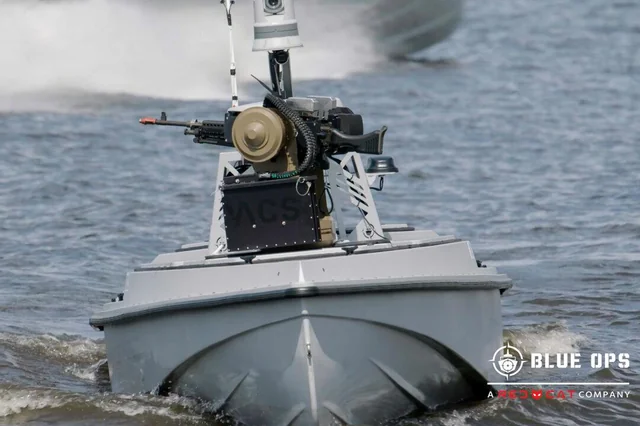
His company’s Blue Ops division makes rigid, single-hull USVs that travel at high speeds close to the water’s surface.
Another U.S.-based company, Ocean Power Technologies, produces a dual-hull, catamaran USV that is more focused on sensing and monitoring, Hinckley said.
Both companies’ drone boats could be teamed together in a “sensor-to-shooter package,” he said.
President and CEO of Ocean Power Technologies, Phillipp Stratmann, said some of his company’s systems are already in service with a U.S. ally in the Middle East.
He told The Epoch Times that the United Arab Emirates, a seven-territory federation on the south coast of the Strait of Hormuz, uses the company’s USVs and “PowerBuoys.”
The buoys harvest energy from waves, wind, and the sun to provide power for offshore and onshore military assets, the New Jersey company’s website says.
These systems help operators “make better and quicker decisions” by providing an overall view of in-theater operations, Stratmann said.
As automation progresses, manned operations can “focus on activities that truly require people,” he said.
That will help the military and companies to save money on daily operating costs as well as on capital-improvement expenses, Stratmann said.
Naval Evolution Underway
USVs are typically about 40 feet long and weigh a few tons—dwarfed by the USS Gerald R. Ford, the 1,106-foot-long, 100,000-ton U.S. Navy “supercarrier.”
With a crew of about 4,500 sailors plus 2,500 air wing personnel, the USS Gerald Ford is widely recognized as the world’s largest aircraft carrier. The United States deployed it to the Middle East to apply more military pressure on Iran, but sent it to a repair station after a laundry-room fire, which was not combat-related.
Both types of vessels and many others in between have their place in naval operations; large naval vessels can be used to transport fleets of small drone boats.
But the recent focus on procuring small USVs represents a major shift, Hinckley said.
“It all started in Ukraine … the country with no navy, yet it sank 25 percent of the Russian Black Sea fleet and drove the rest back into the corner,” Hinckley said. “It was the most doctrinal shift in military naval doctrine in 100 years. It astounded everyone.”
Ukraine has deployed airborne and seafaring drones to counterattack since Russia invaded Ukraine in February 2022.
As a result of what happened in Ukraine, “small boats matter now, and they didn’t for the last 100 years,” Hinckley said. “They were overlooked by large navies the world … they always wanted to build bigger boats.”
Future Forecast
Considering that three-quarters of the Earth’s surface is water, the potential for drone-boat use is considerable, Hinckley said, noting peacetime uses such as coastal border patrol.
The current administration is incentivizing small companies “to play in the innovation game and get started,” which offers a new, quick path into the world of defense contracting, Hinckley said.
His work puts him in touch with young entrepreneurs who are “inventing incredible technologies that we’re putting on top of our USVs.”
For example, Blue Ops recently partnered with Allen Control Systems in Austin, Texas. One of its products is the Bullfrog, a machine gun that can be mounted atop a Blue Ops USV.
“It’s basically turning a gun into a robot with an optical sensor that tracks incoming drones,” Hinckley said.
These Bullfrogs can shoot down “a nine-inch drone at 500 meters away, against an obscured background”—a feat that no human could accomplish, he said.
That type of weapon would prove effective to counter threats in places such as the Strait of Hormuz, Hinckley said.
SVUs have not played a big role in the Iran War because the technology and manufacturing are still scaling up. “I’m sure that everyone there wishes they had more,” Hinckley said. “And I guarantee you that, during the next conflict, they will.
“I don’t think you’ll ever see someone underplay ‘the USV card’ in the future,” he said, “because it’s so important.” (The Epoch Times)