














U.S. presidents have successfully moved to remove Latin American leaders for over a century. What to know about U.S. involvement in coups in the region.
Manuel Noriega, the notorious Panamanian general Marines were sent to capture. Salvador Allende, Chile’s first socialist president who died during a U.S.-backed military coup. Jacobo Árbenz, a progressive Guatemalan president who resigned when his troops fell for CIA propaganda.
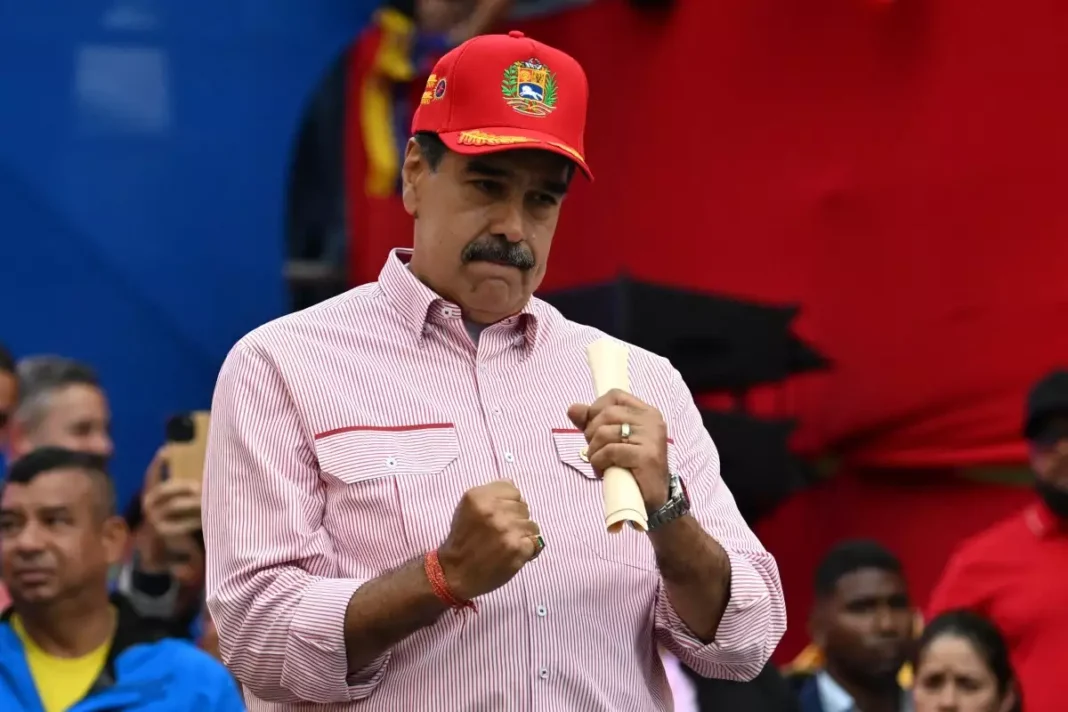
Next up, Venezuelan President Nicolas Maduro?
If President Donald Trump has his way, the Venezuelan autocrat will join a list of Latin American leaders U.S. officials have ushered out of office, dating back to the early 1900s.
“The idea that we now want to determine the future of Venezuela is nothing new,” Stephen Kinzer, an author of books on U.S.-orchestrated regime changes throughout the globe, told USA TODAY. “What’s happening now is very much part of a long tradition where countries in and around the Caribbean are required to accept a global political reality — that smaller countries near a big power have some unwritten limitations on what they can do.”
Official reasons for past U.S.-backed coups include everything from defending American business interests and citizens to installing better governments.
Maduro, White House officials say, is the leader of a drug trafficking cartel designated by the State Department as a foreign terrorist organization. Maduro denies having links to the illegal drug trade.
Public reasons for intervening are usually a cover story, Kinzer says, for a simpler explanation— the White House will not tolerate opposition in its own backyard.
“It’s definitely not about drugs, Venezuela is a minor player,” said Kinzer, who also worked as a New York Times foreign correspondent based in Latin America. “Maduro is defiant, he’s not accepting a geopolitical reality which is that these countries are supposed to respect American hegemony.”
Few of the deposed leaders are household names in the United States, where Latin American politics rarely draw attention. But top U.S. officials carefully watch the nation’s neighbors and have moved several times to topple leaders.
Historians say the U.S.’ efforts to forcefully dictate the shape of Western Hemisphere can be traced as far as the early 1900s when President Theodore Roosevelt instituted his corollary to the Monroe Doctrine, signalling the U.S. was willing to intervene with force. The Monroe Doctrine from the 1800s asked European powers to stay out of the region.
In November, the White House extended the Monroe Doctrine with its own corollary, saying it would act to shape a “Hemisphere whose governments cooperate with us against narco-terrorists, cartels, and other transnational criminal organizations.”
“This is a direct 121 years later extension of the Roosevelt Corollary to the Monroe Doctrine,” said Christopher Nichols, a Woodrow Wilson scholar at the Ohio State University, “an amplification to allow the U.S. to explicitly intervene without justification and not bother to make a case to the world community.”
As Trump continues to bomb vessels off the coast of Venezuela and considers strikes on land, here’s a look at past U.S.-backed regime changes in the region, how American leaders pulled them off and what followed.
A ‘dangerous dictator’ in Nicaragua, 1909
A U.S. president’s first successful move to topple a leader in Latin America came in 1909, when Nicaraguan President José Santos Zelaya resigned after President Howard Taft deployed warships off the Nicaraguan coast and Marines across the border in Panama.
Zelaya came to power in 1893 as a leader in a revolt, according to Encyclopedia Britannica. U.S. leaders initially praised Zelaya. Roosevelt called him a “great and good friend.”
American businessmen soured on the Central American president when he imposed regulations. Corporate executives backed a rebellion in Nicaragua and the Taft administration deployed the military after Zelaya executed two American mercenaries in the rebel army.
According to the State Department, Taft viewed American intervention as a move to remove a “dangerous dictator and install a better government.” The agency says Nicaraguans viewed U.S. intervention as a ploy to take over railroads and banks.
Nicaragua Investiga, a Nicaraguan national news outlet, said that what followed Zelaya’s fall were “years of U.S. dominion over the territory and, as a consequence, Wall Street bankers over the country’s monetary policy.”
Banana mogul targets Honduras, 1911
Miguel Dávila, a president of Honduras installed by Zelaya, fell next in 1911, according to Encyclopedia Britannica.
The Zelaya protégé ran afoul of American business leaders after attempting to impose regulations and limit the land they could own in the country, Kinzer wrote in Overthrow: America’s Century of Regime Change From Hawaii to Iraq.
A rebel army funded by American banana mogul Sam Zemurray invaded. U.S. government officials forbade further fighting and Dávila resigned.
Newly installed president of Honduras Manuel Bonilla awarded “Sam the Banana Man” Zemurray about 35,000 acres of banana land as well as $500,000.
Zemurray became president of the United Fruit Company, a corporation that lives on in Chiquita-branded bananas commonly found in grocery stores.
CIA hoodwinks Guatemala, 1954
Zemurray played a key role in the next regime change in the region: the fall of Guatemalan President Jacobo Árbenz, a former minister of war who came to power with the support of the military and Guatemalan Communist Party, according to Encyclopedia Britannica.
Árbenz tried to redistribute idle land owned by Zemurray’s United Fruit Company and tried to raise taxes on the company, causing Secretary of State John Foster Dulles to become alarmed.
The Central Intelligence Agency, run by Dulles’ brother Allen Dulles, responded by organizing an army of Guatemalan exiles and Árbenz resigned after his troops refused to fight the forces massing across the border in Honduras and El Salvador.
Among the intelligence agency’s tricks, according to Kinzer, was flying planes over the country decked out with Guatemalan insurgency insignia and creating a fake radio station in Miami that broadcasted sham troop movements to create the impression of a massive opposition force.
The US ‘puts Humpty Dumpty on the wall’ in Chile, 1973
U.S. involvement in removing Allende was indirect but crucial, said Peter Siavelis, a Wake Forest University political science professor said on the phone from Chile.
American troops never deployed to the country but President Richard Nixon instituted an “invisible blockade” and the CIA funded right-wing groups, including plotters who wound up killing the general blocking soon-to-be dictator Augusto Pinochet’s rise to the top of the nation’s military.
“The U.S. was not materially involved in the actual coup,” Siavelis said. But “The United States put Humpty Dumpty on the wall, the U.S. made Humpty Dumpty super unstable and made it really easy for Pinochet to come along and push him off the wall.”
Pinochet’s regime was brutal. Thousands were killed, more were tortured and tens of thousands went into exile. Democracy was restored decades later, said the author of multiple books on the country, only because institutions in the country remained strong and the people still held onto democratic traditions.
According to Siavelis, the outcome would likely be worse in Venezuela, where democracy has not been effectively practiced for decades and where the country is heavily fragmented between regional powerbrokers loyal to Maduro.
“The fundamental problem is there’s no day-after plan,” he said. “Overthrowing a regime as weak as Maduro’s is easy. What’s really hard is stabilizing a polarized country where there was no democratic tradition or infrastructure, as we saw in Iraq and Afghanistan.” (https://www.usatoday.com/story/news/politics/2025/12/05/trump-maduro-venezuela-coups-in-latin-america/87592962007/)