
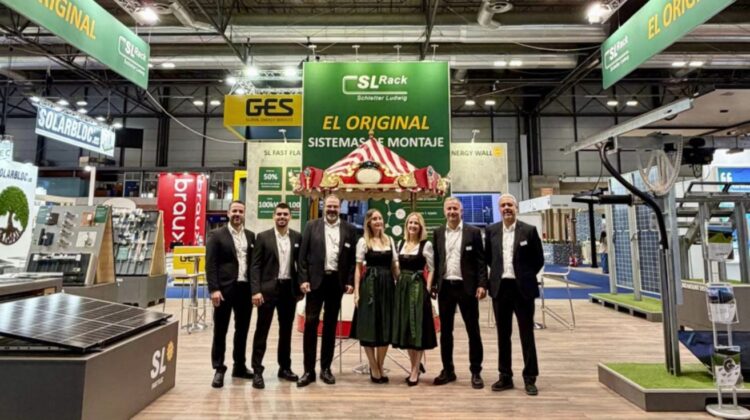















José Oscar Rubí González, Commercial Director at SL Rack, anticipates that the combination of agriculture and solar energy will gain momentum as a technological standard in both regions, which are moving forward with pilot projects and new public incentive schemes. The company is showcasing specialized solutions designed for this model at GENERA. How are industry players positioning themselves in response to this emerging demand?
In a context of intense global competition in the solar sector, agrovoltaics is emerging as a profitable and scalable alternative. The technology is gaining momentum across Europe and beginning to take hold in Latin America, while manufacturers respond with specialized solutions tailored to this new demand.
José Oscar Rubí González, Commercial Director at SL Rack, a European manufacturer of photovoltaic mounting systems, highlights this trend. “Agrovoltaics is strongly supported and subsidized by governments, not only in Europe but increasingly in Latin America,” said Rubí González, emphasizing the company’s active involvement in this segment.
Spain is one of the countries advancing a regulatory framework for this technology. The Institute for Energy Diversification and Saving (IDAE) recently launched €77 million in grants for 62 agrovoltaic projects, each requiring sensors, control plots, and a five-year technical monitoring plan.
Additionally, the Ministry of Agriculture opened a public consultation that includes agrovoltaics under Article 9 of the Common Agricultural Policy (CAP) for direct payments. The challenge ahead lies in aligning this model with traditional agricultural subsidies.
Although Spain is moving forward with pilot projects, the industry recognizes that it still “lags slightly behind” markets such as Italy—where clear objectives are outlined in its national energy plan (PNIEC)—or France and Germany, which already regulate animal welfare standards within agrovoltaic frameworks. The model’s future will depend on the integration of energy regulation, CAP mechanisms, and agricultural sector needs.
Latin America, meanwhile, continues to expand its early-stage pilots. In Chile, a 22 kW system was installed above a cherry orchard in Maule by NobleFruit with participation from seven institutions including the Solar Energy Research Center (SERC Chile). In Colombia, the Guamo and Numbana solar parks integrate camelid grazing beneath panels in installations of up to 9.9 MW developed by Erco Energía and LONGi. In Uruguay, the first agrovoltaic plant is underway in Durazno, led by the Technological University of Uruguay (UTEC).
Regarding the traditional solar PV market, Rubí González observes notable dynamism in Central America and the Caribbean, where SL Rack has already signed a 55 MW project and expects to close an additional 100 MW before year-end.
“We have strong expectations for Guatemala, Panama, Honduras, El Salvador, and especially the Caribbean,” he told Energía Estratégica during the GENERA 2025 exhibition.
He added that the company continues to closely monitor developments in Colombia and Peru, while Mexico remains “the big unknown.”
“Depending on how we see the market evolve, we will decide whether to move forward or not,” he said.
These regional perspectives had already been shared during Rubí González’s participation in the Future Energy Summit (FES), where he analyzed the potential of the Central American market and opportunities for utility-scale solar in Latin America, emphasizing the importance of adapting technical solutions to national contexts.
In Europe, SL Rack is developing agrovoltaic projects between 5 and 20 MW, with the goal of reaching 100 MW in the coming years. In the Iberian region, the company currently focuses on smaller industrial self-consumption systems but expects to scale into larger utility-scale developments soon. During FES Caribe, Rubí González confirmed that SL Rack signed framework agreements with clients in Spain, Italy, Germany, and the Netherlands, ensuring a solid base for growth in these markets.
SL Rack’s targets for 2026 in Iberia and Latin America are specific: the company aims to execute at least 70 MW, with installations adapted to the technical requirements of agrovoltaics.
“In Europe, and particularly in Spain, we will see a return of utility-scale projects next year. Most of them will rely on solar trackers,” Rubí González noted.
He also highlighted signs of recovery in industrial self-consumption during the second half of 2025, a segment where SL Rack is actively working and expects even stronger results in 2026.
As a personal note, Rubí González shared his own story in an interview during the Future Energy Summit, an event circuit that once led the industry in Latin America and Spain, now revisited by Energía Estratégica.
New development: SL Track, SL Rack’s technical bet for agrovoltaics
In this context, the company chose GENERA to present its latest innovation: the SL Track, a solar tracker designed to meet the specific technical demands of agrovoltaic systems. This single-post structure allows tilt angles of up to 90 degrees, improving solar efficiency and optimizing land for agricultural use.
“We are the only manufacturer able to offer this tilt angle with a disc-based system that ensures absolute fixation in every position,” explained Rubí González, noting that this feature is crucial for extreme wind conditions, particularly in the Caribbean.
The solution is compatible with 1P and 2P configurations, adaptable to any terrain, and maintains low maintenance costs. The company also offers flexible production schemes, with 100% European or 100% Chinese manufacturing depending on project requirements.
The tracker allows up to 90° rotation in under six minutes, with a total movement range of 153°. Its pre-assembled, compact design facilitates quick installation, and it is suitable for terrain slopes of up to 10°. Each row integrates a 300 W motor, intelligent control, wireless communication, and specific modes for snow, storms, and maintenance.
As a distinctive detail, the company also produces its own craft beer—an element that strengthens its brand identity and creates informal engagement with clients at trade fairs and industry events. (https://strategicenergy.eu/agrovoltaics-emerge-as-a-profitable-business-model-for-europe-and-latin-america/#)