















Estimated reading time: 4 minutes
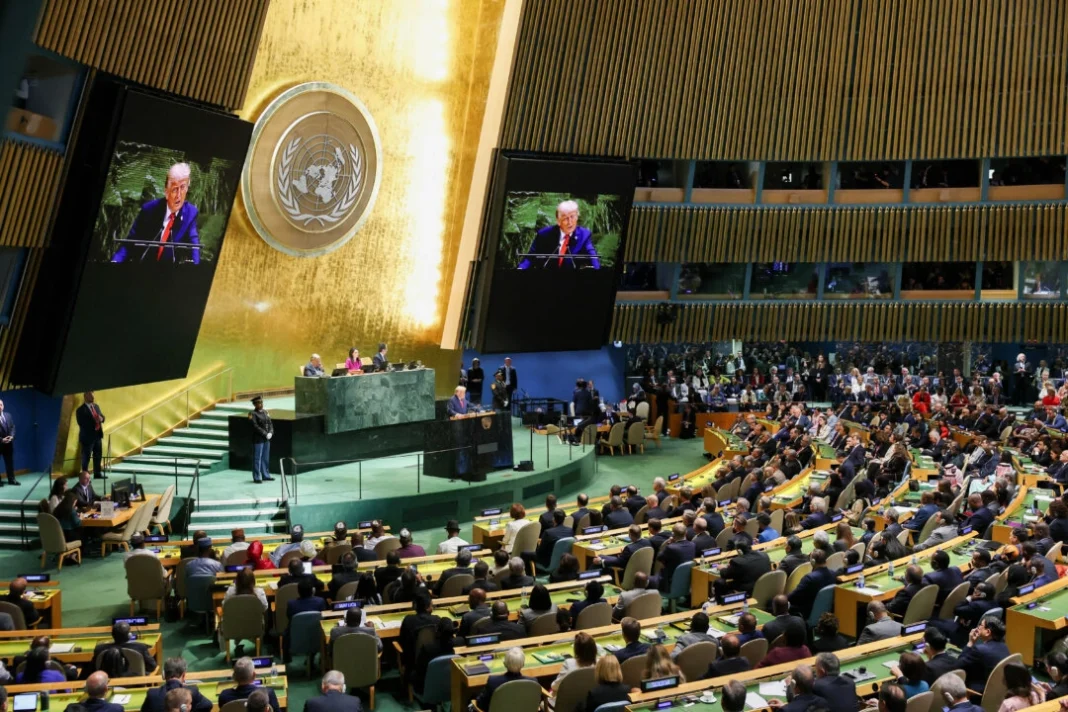
President Donald Trump has denied that the United Nations will have to close its headquarters in New York for financial reasons, and has talked of the organization’s “tremendous potential.”
“When I’m no longer around to settle wars, the U.N. can. It has tremendous potential. Tremendous,” Trump told Politico.
On Jan. 28, U.N. Secretary-General António Guterres wrote a letter to member states warning them of the U.N.’s parlous financial situation.
“The crisis is deepening, threatening programme delivery and risking financial collapse. And the situation will deteriorate further in the near future,” Guterres wrote.
The New York Times reported on Jan. 30, citing unnamed senior U.N. officials, that the U.N. might run out of money by July and be forced to close its headquarters by August due to the non-payment of dues by several member countries, including the United States.
“I don’t think it’s appropriate. The U.N. is not leaving New York, and it’s not leaving the United States, because the U.N. has tremendous potential,” Trump said, according to Politico. An unedited transcript of the call has not yet been released.
Guterres—whose second five-year term will run out in December—warned in October 2025 that the organization faces a “race to bankruptcy” unless member states paid their dues in full, and on time.
Last year, the U.N. budget was cut, and the number of people employed by the organization was reduced from 13,809 to 11,594.
As of Sept. 30, 2025, $1.87 billion was still owed to the U.N. by member states, of which nearly $1.5 billion was from the United States.
Trump Offers to Solve the Problem
Trump, speaking from Florida, told Politico he was unaware the United States owed money to the U.N. but said he was sure he could “solve the problem very easily” if the U.N. asked him.
“If they came to Trump and told him, I’d get everybody to pay up, just like I got NATO to pay up. All I have to do is call these countries,” he said. “They would send checks within minutes.”
In early 2025, he intervened on the matter of NATO funding, urging members to increase their financial contributions to defense spending. With the exception of Spain, NATO members agreed in June to the defense spending increase, targeting 5 percent of GDP by 2035.
It marked the end of a five-month campaign by Trump to make the other NATO members shoulder more of the responsibility in defending Europe.
The Trump administration last month distanced itself from much of the United Nations’ agenda.
On Jan. 7, the Trump administration issued a memorandum that ordered all executive departments and federal agencies to “cease participating in and funding 35 non-United Nations (U.N.) organizations and 31 U.N. entities that operate contrary to U.S. national interests, security, economic prosperity, or sovereignty.”
“Large parts of the U.N. have embraced an ultra-liberal ideological agenda that is detached from reality and intolerant of dissent,” Hillel Neuer, executive director of U.N. Watch, told The Epoch Times in an email.
“This has alienated not only President Trump, but many democratic governments. The U.N. was meant to be a forum, not a political movement.”
Trump recently set up the Board of Peace to handle issues following the cease-fire in Gaza, and suggested it could replace the U.N.
But he later said that while the U.N. has never lived up to its potential, “you’ve got to let the U.N. continue because the potential is so great.”
Guterres will be replaced by a new secretary-general at the end of the year, and at the moment, the only candidate is Rafael Mariano Grossi, the current head of the International Atomic Energy Agency (IAEA).
“A purposeful, performance-driven renewal is needed,” Grossi wrote in his vision statement. “We must improve coordination, eliminate duplication, digitize operations, and align structures with clearly defined goals. Efficiency must serve a purpose, not satisfy a process.”
Last year, the Trump administration also dismantled USAID, which it claimed had been working counter to American interests.
“USAID has little to show since the end of the Cold War,” Secretary of State Marco Rubio wrote in a blog post on the State Department’s website on July 1. “Development objectives have rarely been met, instability has often worsened, and anti-American sentiment has only grown. On the global stage, the countries that benefit the most from our generosity usually fail to reciprocate.” (Reuters/The Epoch Times)